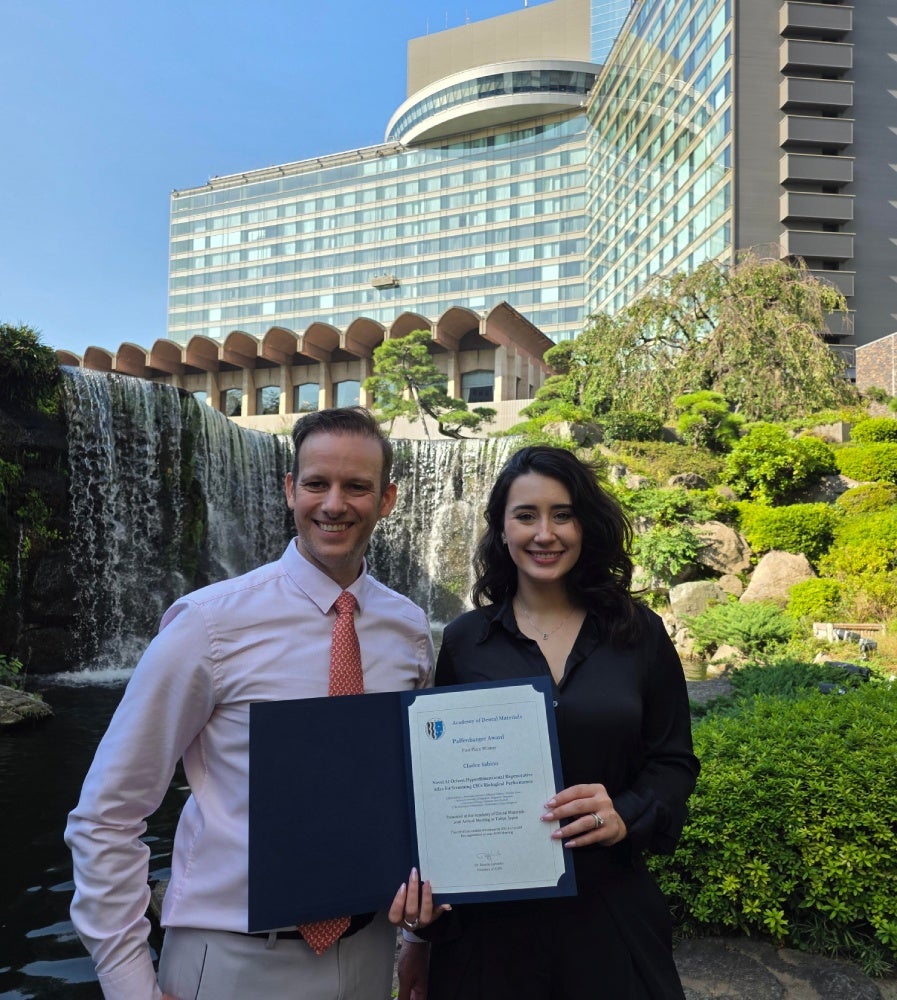
Hot on the heels of receiving the 1st Prize (Senior Category) at the 2026 IADR-SEA Hatton Divisional Competition in September, NUS Dentistry doctoral student Clarice Sabino received the George C. Paffenbarger Award at the Academy of Dental Materials (ADM) Annual Meeting, held in Tokyo from 6–9 October, for her project, “Novel AI-Driven Hyperdimensional Regenerative Atlas for Screening CSCs Biological Performance”, also known as HYDRA.
Project HYDRA explores how artificial intelligence (AI) can help predict the biological performance of calcium silicate cements, materials widely used in dental procedures involving living tissues.
Using AI to predict the biological performance of dental materials
Calcium silicate cements are used in procedures involving living dental tissues, where their biological performance is influenced by a combination of chemical and physical characteristics. These include ion release and changes in local pH, both of which can affect cellular responses and mineralisation.
HYDRA aims to develop an AI-driven approach to mapping and predicting these biological responses. The research is structured around four phases: mapping existing evidence, developing predictive models, constructing the Hyperdimensional Regenerative Atlas, and experimentally validating its predictions.
By identifying promising material formulations earlier in the research process, HYDRA seeks to help researchers prioritise candidates for further investigation before undertaking lengthy biological experiments.
The project’s approach builds on Clarice’s supervisor and NUS Dentistry Research Lead for Novel Diagnostics and Therapeutics, Associate Professor Vinicius Rosa’s team’s published research in the academic journal, Dental Materials, which demonstrates how machine learning can be applied to predict the behaviour of calcium silicate cements. Using early pH measurements taken at three and 24 hours, together with specimen surface area, Assoc Prof Rosa’s team developed a machine-learning model to predict pH behaviour over 28 days.
Laboratory validation showed strong agreement between the model’s predictions and experimental measurements. These findings illustrate the potential of material informatics to reduce reliance on prolonged testing and support more efficient evaluation of dental materials.
A recognition spanning two generations
The award holds special significance for Clarice and Assoc Prof Rosa.
In 2007, while a student at the University of São Paulo, Assoc Prof Rosa received first place for the same award at the ADM meeting in Fort Lauderdale, Florida. His award-winning research examined ion exchange and the mechanical behaviour of dental porcelain.
Nineteen years later, Clarice has followed in her supervisor’s footsteps, receiving the George C. Paffenbarger Award for her HYDRA project.
Although their award-winning projects address different scientific questions and employ different technologies, the two recognitions reflect the evolution of research across successive stages of an academic career. From investigating the mechanical behaviour of ceramics to advancing research at the intersection of materials science, biology, and computational modelling, their work highlights the continuing development of approaches to understanding and evaluating dental materials.
Clarice’s achievement also underscores the potential of AI-driven research to complement experimental methods, helping researchers better understand material–tissue interactions and identify promising directions for future advances in dental materials science.
Congratulations, Clarice!